Problem: Almost 70% of Pharma validation activities are spent on report writing 😔
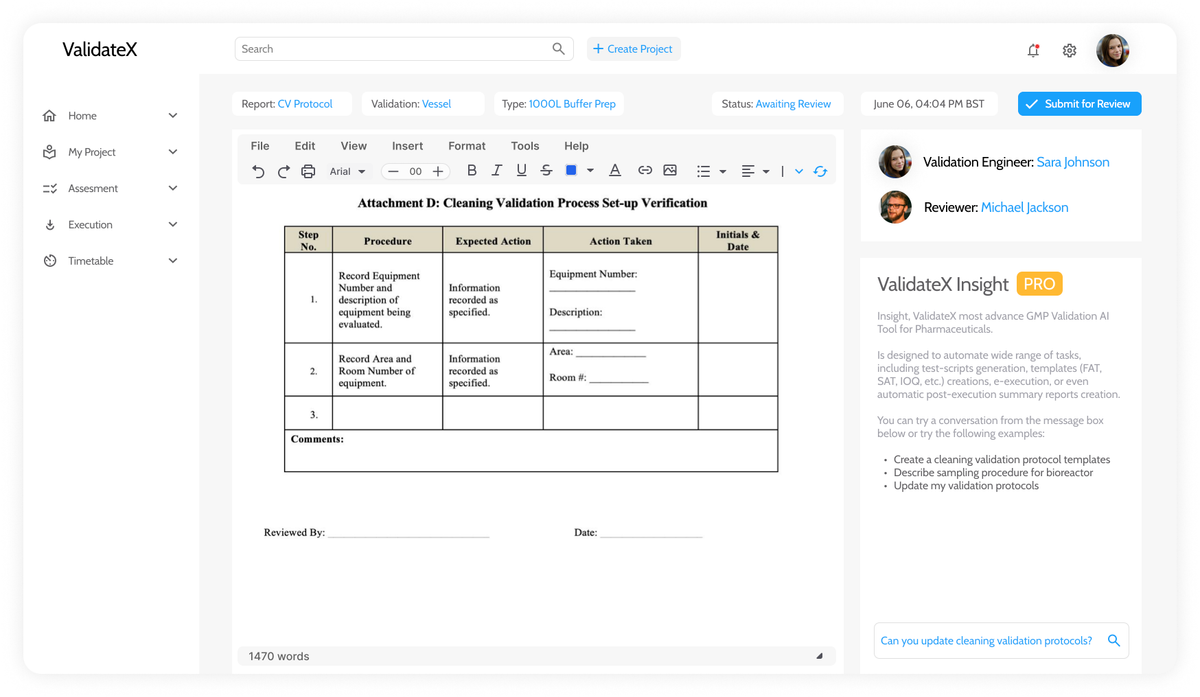
Validation is crucial throughout the drug product development and manufacturing lifecycle to ensure products meet specifications and quality standards. Various types of validation are required to ensure regulatory compliance. Currently, paper or electronic-based validation poses significant challenges in drug production due to its manual and labour-intensive nature.
It involves extensive documentation, manual test execution, and physical approvals, leading to a high potential for human errors and significant delays. This cumbersome process often takes weeks to months, where engineers can spend up to 70% of their time writing validation reports and reviewing deviations.
This is slows down production, prevents process scale-ups, and diverts engineers time from core activities. Additionally, maintaining physical records for compliance and audits is time-consuming and costly, ultimately hindering efficiency and delaying the delivery of critical life-saving drugs to the market.
If you are curious to learn more about validation and its type, then continue reading! Ultimately, any new material, equipment, software, or processes being introduced into a regulated environments will need to be validated.
This can be divided into five main categories for engineers:
Process Validation: There are four types of process validation: prospective, retrospective, concurrent, and revalidation. The FDA defines process validation as "the collection of data from the process design stage throughout production, which establishes scientific evidence that a process is capable of consistently delivering quality products."
Cleaning Validation: This ensures manufacturing equipment is free from contaminants, complying with regulations such as Title 21 CFR Part 211 in the US and similar guidelines from the EMA and PIC/S.
Equipment and Instruments Qualification and Validation (EQV): Ensures manufacturing equipment is correctly installed, functions properly, and consistently produces expected results.
Computer System Validation (CSV) and Computer Software Assurance (CSA): Validates computer systems used in drug manufacturing to ensure data integrity, security, and reliability. CSV is for high-risk systems, while CSA is a streamlined approach for lower-risk systems.
Analytical Method Validation: Confirms that testing procedures produce reliable and consistent results, crucial for compliance and ensuring drug efficacy. Regulatory agencies require evidence that analytical methods are scientifically sound.
Also, there are various types of validation reports which will need to be completed as part of the same project. This includes Factory Acceptance Tests (FAT), Site Acceptance Test (SAT), Installation Qualification (IQ), Operational Qualification (OQ), and Performance Qualification (PQ).
At the moment, because of these regulatory requirements validation engineers spend most of their time writing test-scripts, summary, and deviation reports. This becomes a bottleneck in capacity expansion, production scale-up, and increases unit cost for critical drugs.